It's a World of Cake, Baby!
"World of Cake" is the provisional name for two things :
1) a cross-platform framework for creating experimental sequencers
2) a collection of sequencers written with the framework
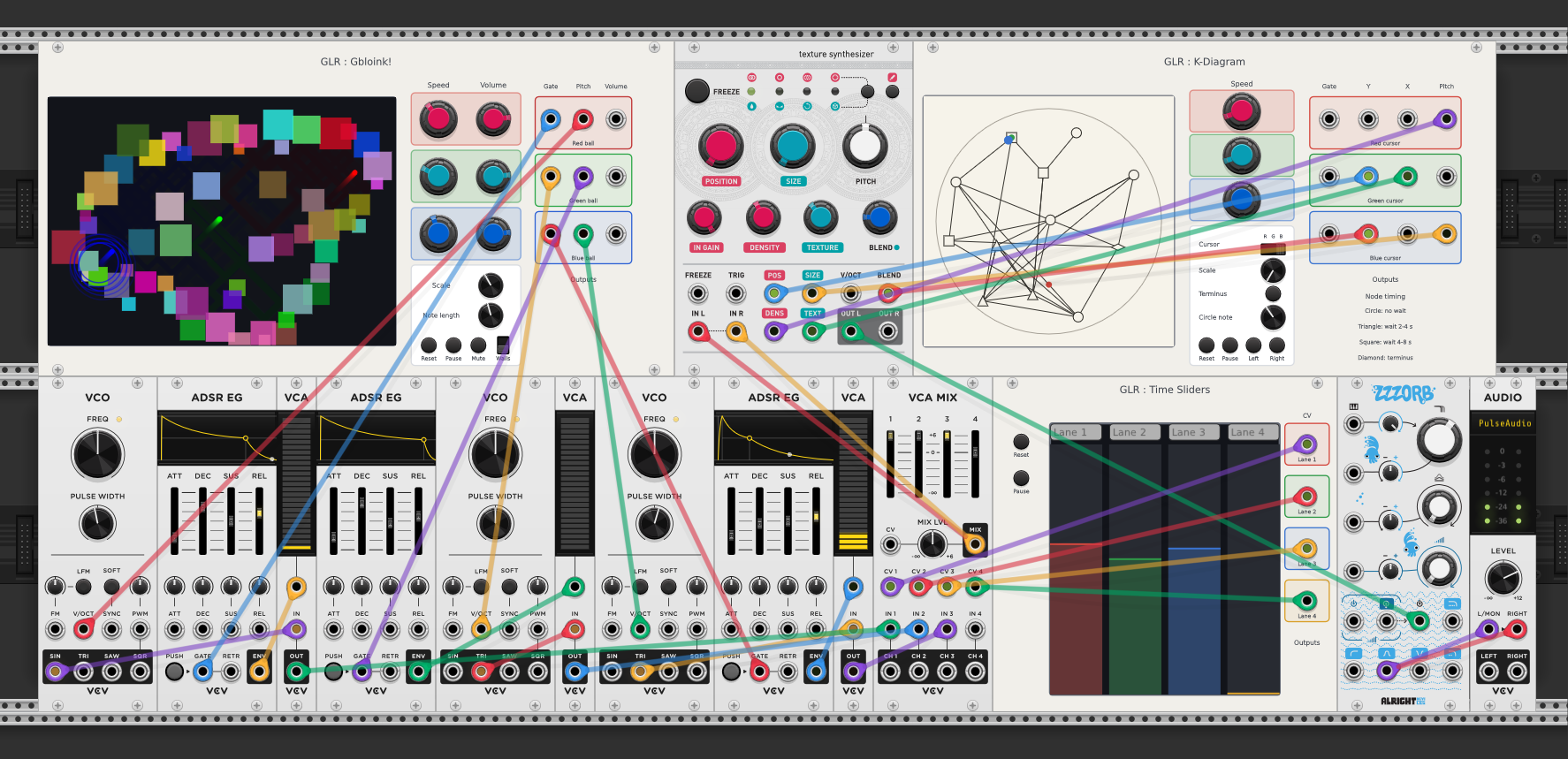
The Framework
The World of Cake framework is intended to provide the common infrastructure for any experiments that involve an interactive surface, playarea or simulation which gives rise to musical events. Those can be both note events such the equivalent of MIDI noteOn and noteOff. Or control events such as MIDI/CC or a single control voltage in an analogue synthesiser.
The framework is written largely in the Haxe programming language, with a small amount of C++ as a wrapper to interface with C++ host platforms where relevant. Sequencers themselves are expected to have the main simulation or control logic written in Haxe. With a layer of app specific C++ to interface them to the
You can see the code on github or gitlab . There's quite a complicated build process behind it so get in touch if you want to try building and running these right now.
The Sequencers
There are four sequencers which are currently in a usable state.
Gbloink!
Gbloink! is an old program. The first version dates back to 1997. See Gbloink! for more on the history and use of Gbloink!
Here's a brief preview of work in progress on the World of Cake version of Gbloink! running as a VST plugin.
TimeSliders
The original "slow controllers". TimeSliders are slider controls which move to their destination over time rather than needing to be dragged explicitly.
You can play with them in the embedded example below. Click anywhere within the slider. The vertical position is the new value you want. But the horizontal position determines how fast the slider moves to it. On the left, the slider moves very slowly. The further right, the faster the slider moves.
As a VCV Rack module the sliders have control voltage outputs. So you can connect them a VCA or VCF cutoff etc. Allowing you to fade multiple tracks in or out, and do several filter sweeps, at the same time. Slow sliders give us the ability to evolve many paramaters at the same time without needing eight hands.
K-Diagram
First written as a Processing sketch for the Brasilia Laptop Orchestra, the "K-Diagram" is inspired by the graph shaped scores of the Brazilian composer Hans-Joachim Koellreutter.
Three cursors wander around the graph triggering note events when they arrive at a new node. And also continuously outputting their X and Y coordinates as continuous control values. While the note events trigger the synthesizer, the control values can modify the parameters of the synth or effects.
In the video below the K-diagram controls three synthesizers (including the legendary Delay Lama), while controls are also updating reverb and glitch effects. The whole thing is also going through a pair of long echo-loops to build up a busier background texture.
Goldenpond
This is Goldenpond in plugin form.
World of Cake in Strudel
World of Cake sequencers are coming to Strudel too.
Go to our custom Strudel and paste in the following :
This works best if you change the Gbloink! scale to minor blues and make the note length a little longer (bottom right knob on Gbloink!)
setcpm(55);

// Create an instance of Gbloink!, TimeSliders and K-Diagram

const gb = gbloink('gb');
const ts = timeslider('ts');
const kd = kdiag('kd');

// A rhythm section

// note the wocc() function produces a world of cake control signal.
// Here we use the first of the timesliders to control the
// filter cutoff on the drums.

$: s("[<bd [x bd]> <hh oh>]/2").bank("tr909")
  .dec(.2).delay(0.3)
  .lpf(wocc(ts,0).range(100,4000)).gain(0.2);
$: s("[x sd x <sd [lt lt]>]/4").bank("tr606").gain(0.3);

$: n("[0 [0 2 3] 0 4]/2".add(24)).scale("D3:major").sound("gm_woodblock");
$: n("[0 x 0 3]/4".add("<-12 0 -24>")).scale("C3:minor")
  .gain(slider(0.4,0,1))
  .sound("gm_slap_bass_1").jux(rev);

// Connect the red ball (gb,0) to a triangle instrument. And its gain to the second timeslider
$: wocline(gb, 0).s('triangle').delay(0.5).gain(wocc(ts,1).range(0,1));

// Connect the green ball (gb,1) to a muted trumpet. And its volume to the gain timeslider
$: wocline(gb, 1).s('gm_muted_trumpet').room(0.6).delay(0.3).dt(0.5).gain(wocc(ts,2).range(0,1));

// Connect the blue ball (gb,0) to a voice oohs instrument.
// And its gain to x position of the red cursor of the k-diagram
$: wocline(gb, 2).s('gm_voice_oohs').delay(0.3).gain(wocc(kd,0).range(0,1));